%20Square%20Ad-01.jpg&w=640&q=75)
%20Square%20Ad%20-02.jpg&w=640&q=75)
features
The story of WeWork, a cautionary tale of how flawed governance, unchecked ambition, and an unsustainable business model can undermine even the most promising ventures.

Illustrated By sk. yeahhia
21 August, 2025
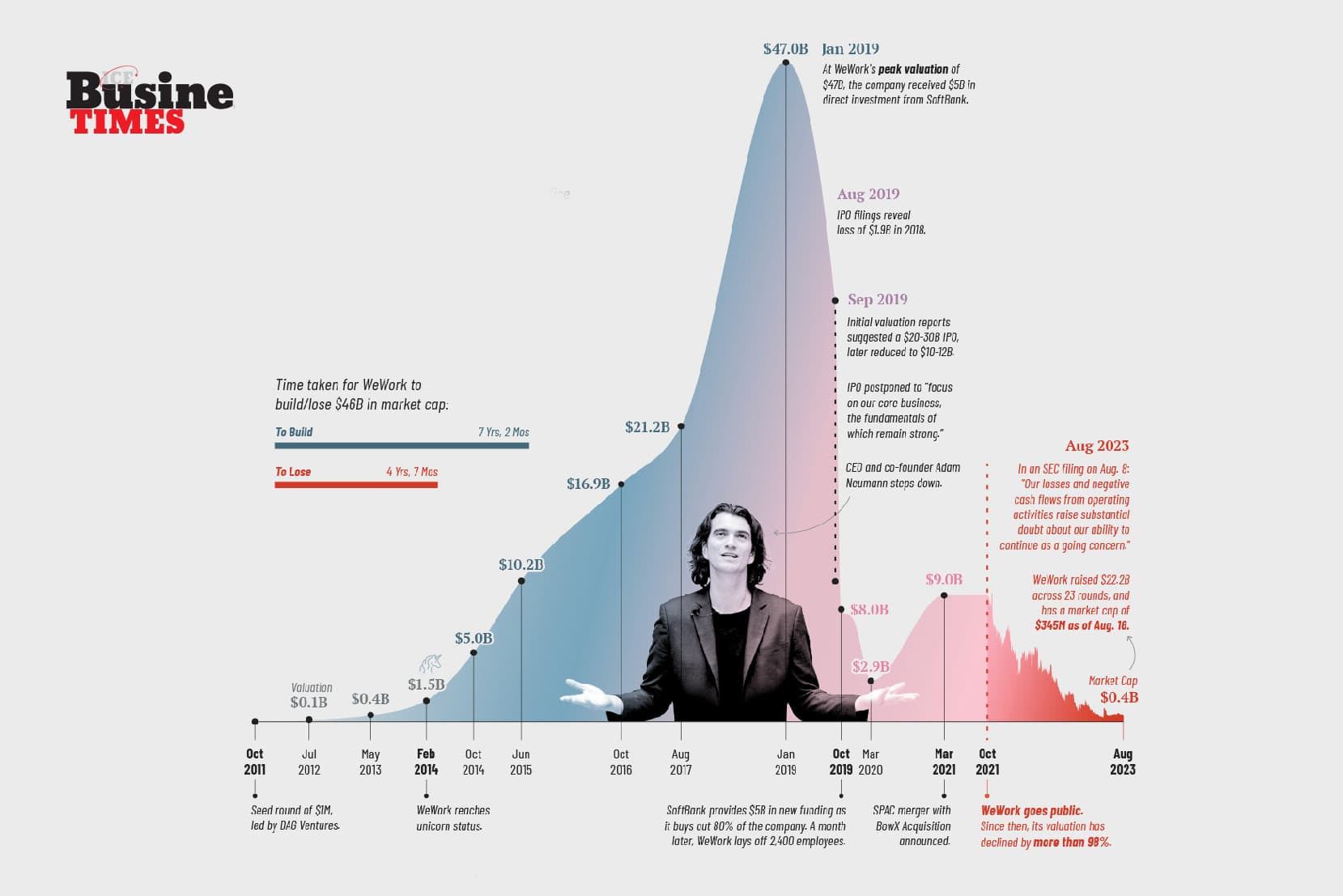
At one point, WeWork was the most valuable startup in the United States after Uber, boasting a valuation of USD 47 billion. It promised nothing less than a revolution in the way people worked. Co-working spaces, flexible leases, a global network of beautifully designed offices, WeWork seemed poised to redefine commercial real estate for the 21st century. But within months, that dream unravelled. The company’s failed IPO in 2019 revealed a house of cards built on questionable leadership, an unsustainable business model, and Silicon Valley’s tendency to prioritise hype over fundamentals.
A Lucrative Idea
Founded in 2010 by Adam Neumann and Miguel McKelvey, WeWork positioned itself as more than just a real estate company. In practice, WeWork rented office buildings, redesigned them with sleek interiors, and subleased them to freelancers, startups, and eventually enterprise clients, but, the real product wasn’t just space. It was ‘community’. Neumann sold WeWork as a movement, not a business, and that pitch was wildly successful.
Venture capital poured in. SoftBank, led by Masayoshi Son, invested more than USD 10 billion in WeWork, betting that Neumann was the next Steve Jobs. Each funding round inflated WeWork’s valuation, even as its losses grew. The company expanded aggressively, launching in dozens of cities, acquiring side businesses like coding bootcamps and wave pool companies, and even branding itself as “The We Company” to extend into education, housing, and wellness. For a while, the world bought into the fantasy, and while WeWork became a symbol of the future of work, the company’s business model was deeply flawed.
Cracks Beneath the Surface
At its core, WeWork leased long-term real estate at fixed costs and rented it out short-term at variable rates. This mismatch between liabilities and assets meant the company was dangerously exposed to economic downturns or shifts in occupancy. Unlike a traditional tech startup, WeWork had significant capital expenditure. It wasn’t scaling software, it was scaling rent. Despite this, WeWork was haemorrhaging money. In 2018, the company reported revenues of USD 1.8 billion and net losses of USD 1.9 billion. Rather than pull back, it doubled down on expansion. It made bold moves into global markets, launched experimental side ventures like WeLive (co-living spaces) and WeGrow (a private school), and even started acquiring buildings through Neumann’s own real estate deals, often leasing them back to WeWork - a major major conflict of interest.
Unlike a traditional tech startup, WeWork had significant capital expenditure. It wasn’t scaling software, it was scaling rent. Despite this, WeWork was haemorrhaging money.
The IPO Unravelling
In August 2019, WeWork filed to go public, but the prospectus exposed the company’s inner workings. Beyond the financials, which showed staggering losses and no clear path to profitability, the document raised eyebrows for its cult-like tone and revelations about Neumann’s control over the company.
Neumann had created multiple share classes that gave him near-total voting power. He trademarked the word “We” and charged the company USD 5.9 million to use it. He appointed friends and family members to executive roles and had a private jet at his disposal, all funded by investor money. The IPO document painted the picture of a company less grounded in business discipline and more rooted in personality-driven chaos.
Investors baulked, and media scrutiny intensified. Within weeks, WeWork’s IPO was postponed, and its valuation dropped from USD 47 billion to under USD 10 billion. By September 2019, Adam Neumann was forced to resign as CEO under pressure from the board. SoftBank eventually took over control of the company, spending billions more to rescue what remained.
A New and Humble WeWork
After the failed IPO, WeWork became a drastically different company. Neumann exited with a USD 1.7 billion golden parachute, a controversial figure given the damage under his leadership. Thousands of employees were laid off, assets were sold off, and side ventures were shuttered.
The new leadership, under real estate veteran Sandeep Mathrani, focused on core office leasing, trimming costs, and rebuilding trust. In 2021, WeWork finally went public via a SPAC (Special Purpose Acquisition Company) at a valuation of around USD 9 billion, far from its former glory, but a sign that the company still had a place in the market.
WeWork’s rise and fall encapsulate the contradictions of startup culture - the tension between vision and viability, disruption and discipline. For all the talk of "changing the world," WeWork ended up exposing the cracks in Silicon Valley’s growth-at-all-costs mindset.
Today, WeWork still exists, albeit on a more modest scale. The co-working trend it helped popularise lives on, even if it’s now led by other players. But the real legacy of WeWork may lie in its warning - a bold reminder that without structure, even the most inspiring visions can collapse under their own weight.

%20Square%20Ad%20-10.jpg&w=640&q=75)
%20Square%20Ad%20-11.jpg&w=640&q=75)
%20Horizental%20AD-01.jpg&w=3840&q=75)
