%20Square%20Ad-01.jpg&w=640&q=75)
%20Square%20Ad%20-02.jpg&w=640&q=75)
features
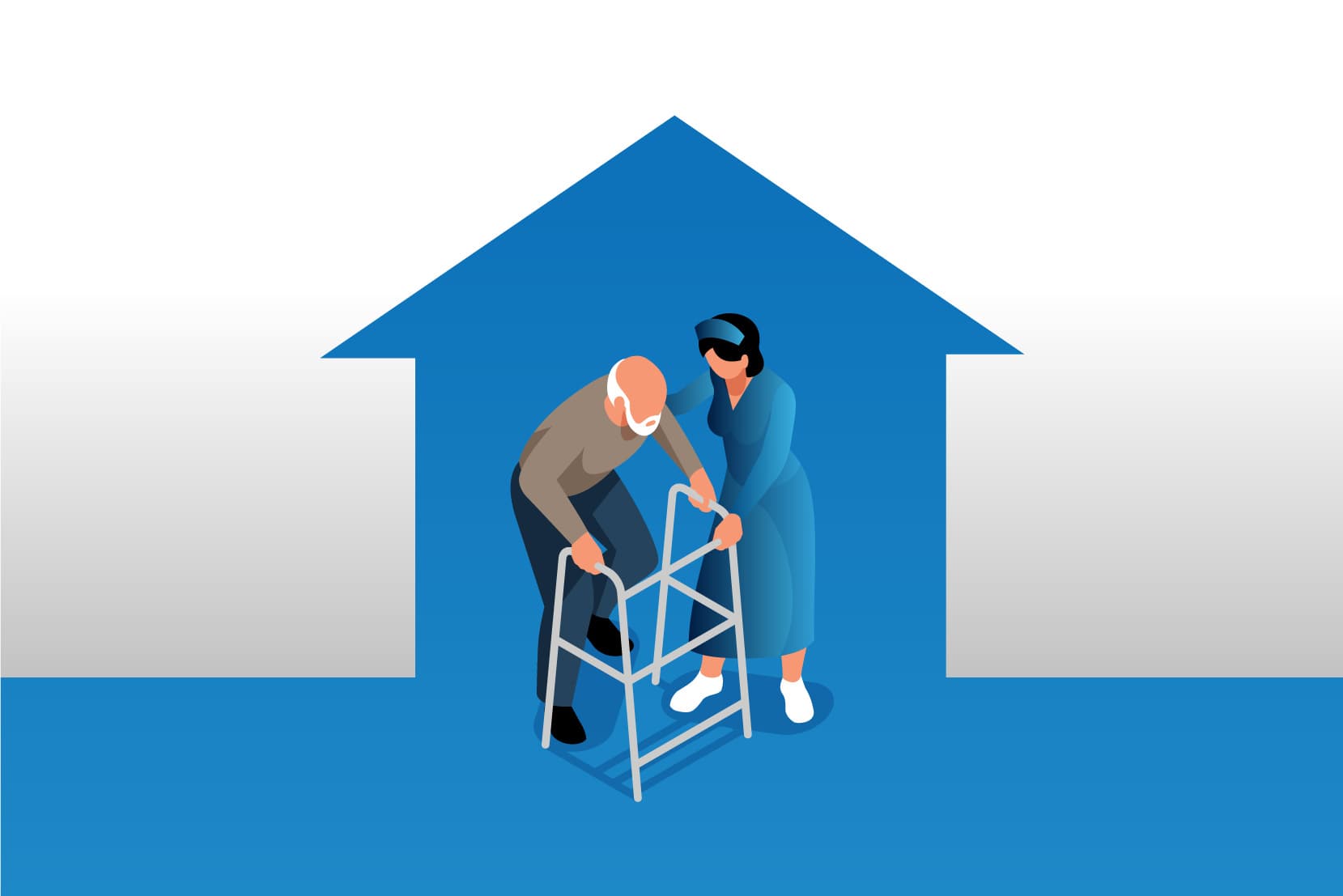
Insights from Dr Zahiruddin Mahmud, CEO of Healthcare at Home, on comprehensive at-home care for seniors, whether this newly emerging industry is adapting fast enough to the needs of the growing ageing population of Bangladesh, and the challenges of the sector.

Illustrated By sk. yeahhia
7 September, 2025
It is pretty wild to think that even as recently as 2013, Bangladesh was hitting the news for its young population and the demographic dividends it would reap. A report published in The Daily Star just last year shows that the proportion of the population aged 65 and above rose to 6.14% in 2023, up from 5.67% a year before, according to the key findings from the Sample Vital Registration System 2023 of the Bangladesh Bureau of Statistics (BBS). The dependency ratio of people who are over 65 rose to 9.4% in 2023, from 8.6% in 2022. The shift, while largely invisible, has nevertheless been palpable.
The weight of these numbers makes itself felt in times of crisis, and it goes beyond economic concerns, which aren’t inconsiderable to begin with. The COVID-19 pandemic underscored the vulnerability of our seniors, as well as the gaps in our system that make it harder to provide adequate care to ailing elders.
Ageing in Place and the Argument for Home Health Care
Research conducted by the Gerontology Department of the University of Nebraska outlined six common afflictions associated with ageing that impact daily life, and these include, but aren’t limited to, mobility issues, audiovisual impairment, cognitive decline and memory loss. The risk of falling and sustaining serious injuries rises exponentially.
With old homes not widely available and regular hospital visits a huge financial burden on a lower-middle-income economy, an ecosystem of home care seems to be the most optimal arrangement for long-term care of senior family members.
Modern Convenience
Dr. Zahiruddin Mahmud, CEO of Healthcare at Home (HCAH), a home healthcare company, shared with us his personal experience of being unable to find a nurse to take care of his ailing mother at home, and how all the insights he gained from setting up a care management system for her along with his siblings prompted him, after his mother’s demise, to start a service for families in similar situations.
Since its inception, HCAH has gone from a small team to a workforce of some 230 trained attendants around the country. The company provides attendants and caregivers, consultation and counselling for the families of the clients, physiotherapy support, post-stroke care, and has recently introduced at-home ICU setups and nanny services for children.
“Services like ours, we pay the attendants and home assistants more for the same kind of specialised work they do at hospitals,” shares Dr Mahmud, adding “Moreover, the deals with the homes they work in frequently make provisions for meals, so they’re getting salaries, room and board; the patients are getting individualised and affordable care in a familiar and comforting environment, and their families are getting peace of mind. It is a solution that benefits everyone. Even hospitals benefit from reduced pressure on them for long-term patient management.”
Other notable names in the emerging eldercare industry include Sajida Foundation’s Home and Community Care Limited (HCCL), which proudly advertises its in-house training facilities, assessments, background checks and guarantor processes, which help to alleviate some of the security concerns that families of the clients have regarding the vulnerable patients; and Olwel, a Finland based digital hospital that offers home health services in Bangladesh, including doctor visits, sample collection and virtual consultations.
With old homes not widely available and regular hospital visits a huge financial burden on a lower-middle- income economy, an ecosystem of home care seems to be the most optimal arrangement for long-term care of senior family members.
Peace of Mind
The core of these business practices is to reduce the hassle of commuting and to minimise the time that patients spend in hospitals. Many, if not most, adults wish to maintain their independence as they age, typically in the homes they have lived in for many years. Given the lack of availability of care homes, and the stigmas surrounding these homes, this is practically the only option in Bangladesh anyway, but it is far from ideal. What has to be taken into account is that these familiar home environments increasingly create physical barriers when age-related ailments begin to creep up.
Dr Mahmud is seeking to address some of these issues through HCAH’s at-home ICU and hospital setup. “Previously, it was thought that if you reach 60, your life is over. Now, thanks to modern medicine, life expectancy is increasing, and we have to adapt our ways so that elderly people can feel normal, feel comfortable, especially in their own homes.”
Challenges and Pushbacks
When asked about challenges and barriers to growth, Dr Mahmud cited the standard of education in applicants for home assistant roles. “My minimum requirement is SSC/Class 10 pass, because they have to be able to read prescriptions and follow precise instructions. I get many applications, but frequently they don’t have even that, and sometimes, even when they do, they struggle during the training. The job requires a lot of sensitive technical and practical skills, like measuring blood pressure, sugar, injecting insulin, operating the nebuliser and so on. I’ve seen a lot of trainees quit halfway.”
A lack of industrial regulation in this sector also means that there is a lot of job hopping between these companies and newer boutique home care services that have begun to crop up. “I’ll spend months training some of the workers and then they’ll move to a different company, and that’s also a challenge I have to take in stride,” Dr Mahmud laments.
Another big issue that comes from the customer side is the lack of awareness of the rights and responsibilities of the home assistant. Because this system is still relatively new in this country, which has an established socio-economic hierarchy, there have been cases where the families of the patient often don’t maintain professional decorum with the caregivers. “People need to understand that the caregiver is a trained nurse or medical staff; you can’t treat them like the house help - not that I am advocating for the mistreatment of house help either,” Dr Mahmud says, adding “I have had complaints of caregivers being denied meals, or forced to do household chores outside of their JD (job description); some even face verbal abuse or physical threats. We have had to replace and reassign a few workers in the past five years, and in extreme cases, terminate the contract.”
The Future of Care
It is when we breach the subject of the future of elder care that things get really interesting. Dr Mahmud posits that the future of elder care - if not all healthcare - will be post-human. “You’re already seeing robot-assisted surgery, non-invasive health tests, and AI-assisted health screening. A robotic assistant that doesn’t get fatigued by a dementia patient, doesn’t take things personally when having to perform unpleasant tasks, and is able to make quick decisions and make speedy risk assessment might in the end become a more lucrative option for the patients and their families,” he says.
According to the United Nations Population Fund (UNFPA), by 2050, people aged 60 and above in Bangladesh will number 3.6 crore and constitute 22% of the total population. Is a robotic future their ultimate recourse? We’ll soon find out.

%20Square%20Ad%20-10.jpg&w=640&q=75)
%20Square%20Ad%20-11.jpg&w=640&q=75)
%20Horizental%20AD-01.jpg&w=3840&q=75)
