%20Square%20Ad-01.jpg&w=640&q=75)
%20Square%20Ad%20-02.jpg&w=640&q=75)
Local Economy
As Bangladesh awaits a UN decision on its request to delay LDC graduation, the nation risks the loss of vital economic privileges like duty-free market access and intellectual property exceptions for generic drugs.

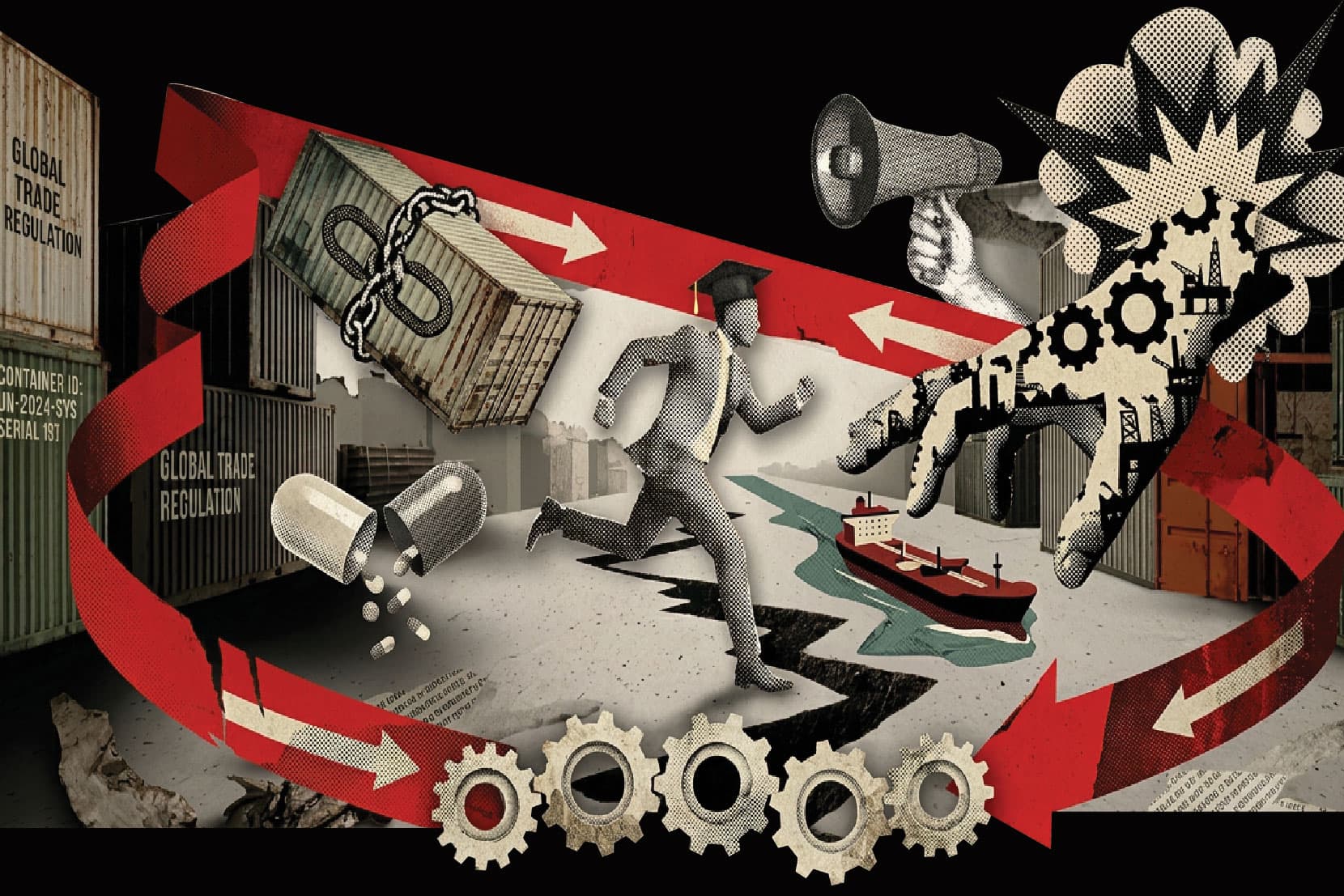
Illustrated By sk. yeahhia
4 April, 2026
Bangladesh is scheduled to graduate from Least Developed Country (LDC) status in November 2026 — pending the resolution of a request made by the Government to the United Nations Committee for Development Policy to postpone it by 3 years. If graduation goes through, not only would we lose duty-free perks, we would be doing so in an increasingly polarised world where the rules-based order grows weaker each day.
From LDC Advantage to Graduation Reality
The LDC category was established by the UN General Assembly in 1971 as an acknowledgement that special support was needed to assist developing countries suffering from structural impediments. Bangladesh joined the list in 1975. Membership into the list is voluntary, but graduation is mandatory - triggered when at least two of three metrics cross preset thresholds in two consecutive triennial reviews by the UN Committee for Development Policy (CDP). Bangladesh is the only LDC so far to have all three metrics (Gross National Income per Capita, the Human Assets Index, and the Economic & Environmental Vulnerability Index) crossed their respective thresholds, in both the 2018 and 2021 reviews.
On the surface, this is a great credit to the nation. But below that surface looms certain risks.
Bangladesh currently has the 33rd largest economy in the world in nominal terms, and 26th largest by purchasing power parity. A large part of this growth has been driven by the ready-made-garments sector, supported by the country’s status as an LDC.
Tariffs, TRIPS, and the Transition Challenge
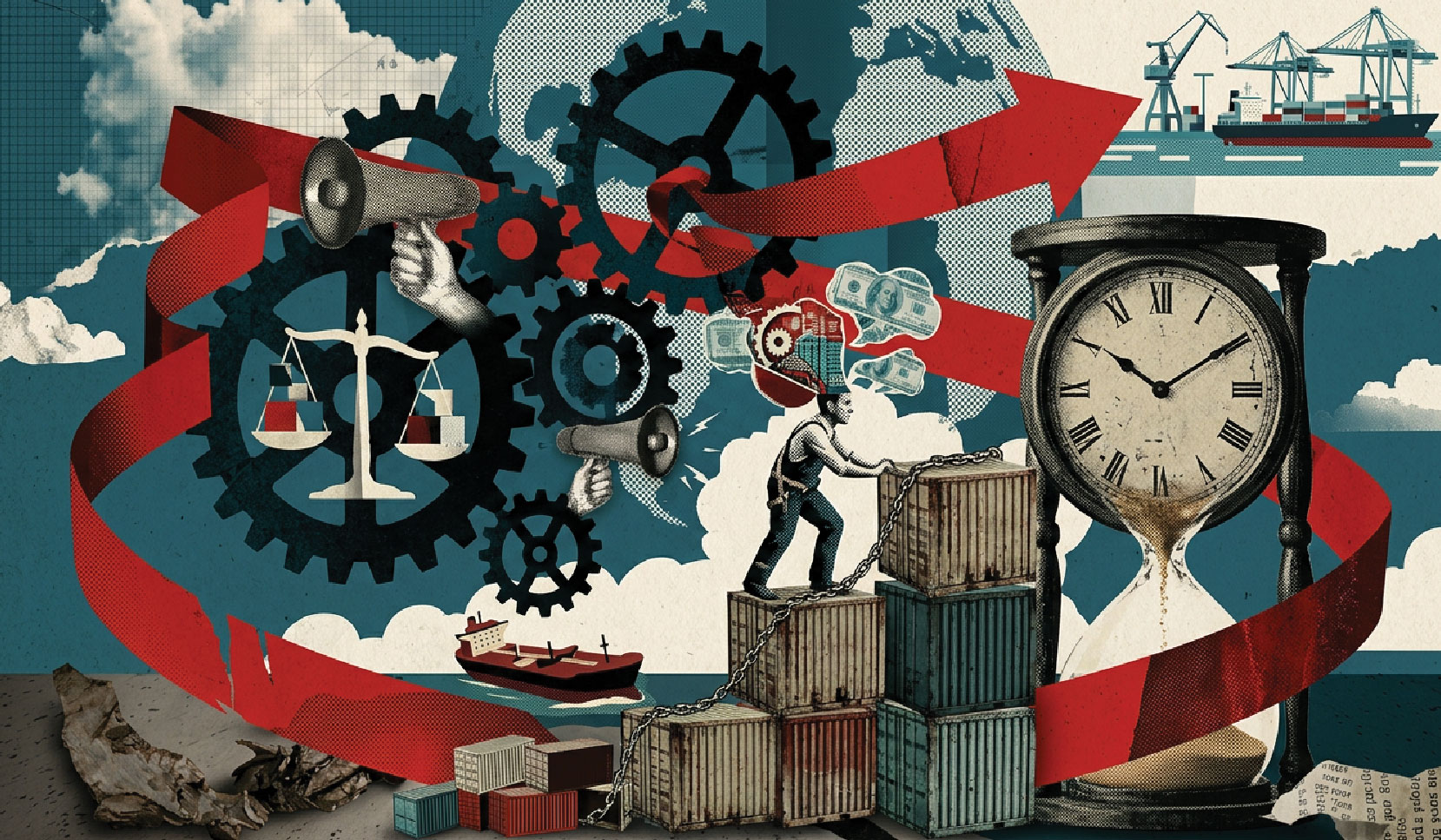
LDC-status has given the nation preferential access to many foreign markets - especially duty-free and quota free access to markets across the EU, which accounts for 48% of the country’s apparel exports. With graduation, tariffs could rise to between 9.6% and 12% in the EU by 2029, 16–18% in Canada, and 7.4–12.8% in Japan. The saving grace would be a 3-year transition period in the UK and EU, but beyond this Bangladesh not only faces tariffs, but stricter “rules of origin” regulations. For apparel, this means that at least two transformations take place in the country (eg, yarn→fabric and fabric→garment, or fabric→cutting and cutting→sewing, instead of just one stage). This remains a challenge in certain segments like the woven garment segment which is reliant on imported fabric.
These changes will require Bangladesh to form new bilateral agreements and the nation is sadly late to the party, as Vietnam, a close competitor in the sector, is enroute to zero tariffs with the EU by 2029.
At the same time, WTO’s TRIPS agreement allows LDCs to reproduce generic versions of patented drugs without paying costly licensing fees. With this legal shield, Bangladeshi Pharmaceutical Companies have been able to easily source active pharmaceutical ingredients, and in some cases even reverse engineer medication. The industry is now valued at more than USD 3.5 billion, and exports to 150 countries after satisfying 98% of local demand. LDCs have access to these benefits till 2034, which Bangladesh would lose after graduation. This means medication can cost a lot more to produce, which beyond export implications could spell trouble in a nation where 70% of all medical expenses comes out-of-pocket. Finally, there is also financing, where we would be losing the World Bank Group’s International Development Association’s 0.75% interest rate and will have to pay 2% instead.
Global Uncertainty Meets a High-Stakes Transition
To top it off, all of this will happen in an increasingly polarised world. In a world of rampant protectionism, of “reciprocal tariffs” imposed without much recourse, not to mention the latest conflict in the gulf and the closure of the Strait of Hormuz.
With graduation, tariffs could rise to between 9.6% and 12% in the EU by 2029, 16–18% in Canada, and 7.4–12.8% in Japan. The saving grace would be a 3-year transition period in the UK and EU, but beyond this Bangladesh not only faces tariffs, but stricter “rules of origin” regulations.
Tariffs, TRIPS, and the Transition Challenge
Even without the recent war, these were some gigantic paradigm shifts, and the Bangladeshi government had formulated the Smooth Transition Strategy in February 2025 in response. The strategy aims to tackle the transition in 5 pillars: Macroeconomic Stability and Fiscal Resilience, Securing Trade Preferences and Transition Measures, Promoting Export Diversification and Competitiveness, Building Productive Capacity and Infrastructure, and Fostering International Partnerships and Cooperation. Creating stability and securing new trade preferences and partnerships notwithstanding, the highlight of this plan is a “high-road approach” to the economy, aimed at shifting from a focus on cost-competition to one in value, innovation, and meeting international standards in quality and compliance. This would be driven by human capital development and upskilling, an increasing focus on R&D, stringent quality control and structural & policy reforms.
However, since the plan’s unveiling in 2025, reports in national dailies have quoted several focus groups raising concerns regarding the progress. Some of these groups, including the Bangladesh Chamber of Industries (BCI), have requested for the government to ask for an extension. But until this year, Bangladesh seemed steady in the path of graduation by November 2026. In February 2026, the GoB filed for an extension of the preparatory period for graduation under the crisis response provision of the UN CDP’s enhanced monitoring mechanism.
Extensions or deferrals of graduation are usually offered for serious extenuating circumstances like severe natural disasters and global pandemics. Up until recently, a strong case for one may not have existed. US & Israel’s war on Iran and Iran’s subsequent closure of the Strait of Hormuz may have just changed that.
The committee's response is expected to come later this year. Until then, it is a race to see how thoroughly we can prepare.

%20Square%20Ad%20-10.jpg&w=640&q=75)
%20Square%20Ad%20-11.jpg&w=640&q=75)
%20Horizental%20AD-01.jpg&w=3840&q=75)
