

Local Economy
Macroeconomic shocks, including persistent inflation and currency depreciation, are driving a structural redefinition in Bangladesh’s retail landscape, compelling businesses to transition from growth maximization to capital efficiency.

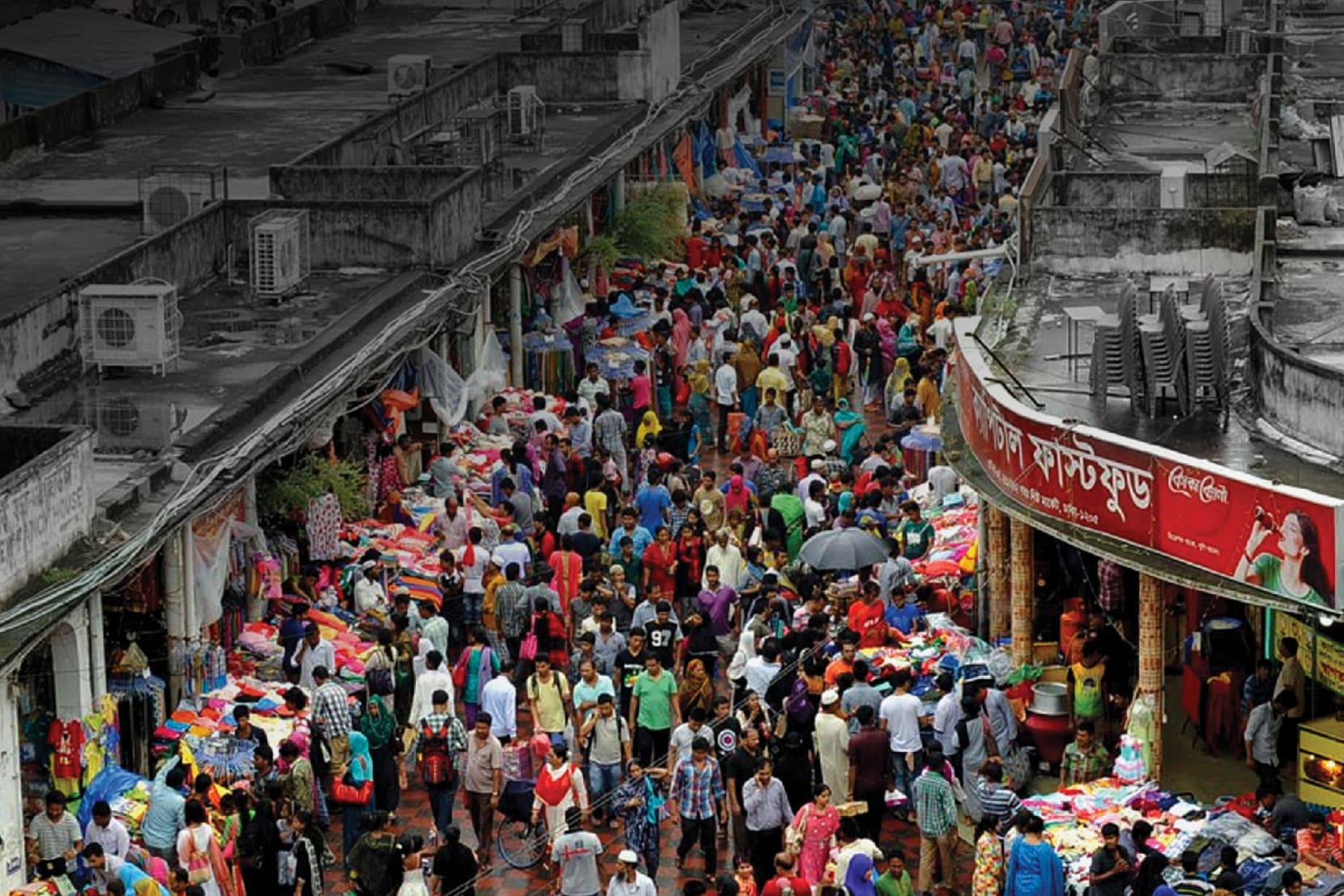
Photograph collected
13 April, 2026
Bangladesh’s retail sector has always been less a standalone industry and more a reflection of the country’s economic pulse. Over the past few years, that pulse has been irregular; sometimes racing under inflationary pressure, sometimes slowing under demand contraction, and often struggling to find rhythm amid policy uncertainty. The result is not a collapse, but a prolonged squeeze that has reshaped how small shops, mid-sized brands, and large retailers should operate, survive, and think about the future.
To understand the present moment, it is important to recognise just how central retail is to Bangladesh’s economic structure. According to the latest economic census, wholesale and retail trade account for over 40% of all economic units in the country, which means the sector functions less like a vertical and more like connective tissue across the economy. Hence, any disruption here transmits quickly into employment, informal credit, and even upstream manufacturing. But what has changed since 2022 is the nature of the disruption itself.
Demand Disruption and Margin Squeeze
The roots of the current crisis lie in a convergence of macroeconomic shocks. Inflation has remained persistently high, hovering around 8 – 9% in late 2025, after peaking in double digits the year before. For a country where consumption makes up roughly three-quarters of GDP, even a slight erosion in purchasing power cascades quickly into reduced retail demand. So, consumers are not just spending less; they are stretching decision cycles. The frequency of purchase has dropped faster than basket size, which creates a deceptive revenue pattern where occasional spikes mask a thinning baseline. For retailers, this introduces a forecasting problem as traditional demand planning, which is largely intuition-driven, breaks down when consumption becomes episodic rather than continuous.
At the same time, the depreciation of the taka, over 40% against the dollar since 2021, has fundamentally reshaped cost structures. Import-dependent categories, particularly in fashion, electronics, and lifestyle retail, have seen the cost of goods sold inflate at a pace that pricing power cannot keep up with. This has led to margin compression that is not immediately visible in topline figures. Retailers may report stable revenues during peak seasons, but gross margins are quietly eroding underneath. The more nuanced issue, however, is inventory financing. In Bangladesh’s retail ecosystem, inventory is effectively the primary use of capital. When input prices rise and demand becomes unpredictable, inventory turns slow down. This creates a liquidity trap: cash is locked in stock that moves slower, while suppliers demand faster payments due to their own cost pressures. The result is a shortening of payable cycles alongside a lengthening of receivable cycles; an inversion that squeezes working capital from both ends.
The depreciation of the taka, over 40% against the dollar since 2021, has fundamentally reshaped cost structures. Import-dependent categories, particularly in fashion, electronics, and lifestyle retail, have seen the cost of goods sold inflate at a pace that pricing power cannot keep up with.
Strain Across the Retail Spectrum
Layered on top of this is a fragile macroeconomic environment marked by declining private investment, falling foreign reserves, and political transition. The turbulence of 2024–2025, including policy disruptions like the nationwide revenue administration strike that temporarily halted customs and tax services, directly affected inventory cycles and supply chains. Retailers, particularly those dependent on imported goods, faced delays, unpredictable pricing, and cash flow mismatches. Most small retailers experience this as a cash flow suffocation. Their business models rely heavily on high turnover and thin margins. Inflation disrupts both sides of that equation. Input costs rise immediately, but selling prices cannot adjust as quickly without losing customers. Their traditional buffers are weakening under systemic stress, because what used to be a relationship-driven credit system is becoming more transactional. Suppliers are less willing to extend credit when their own import costs are volatile. As a result, small retailers are de-risking by understocking, which further limits their ability to capture demand when it does appear. The retail slowdown is also visible in anecdotal sales declines, with some segments reportedly seeing sharp drops during periods of restricted operating hours or reduced consumer footfall.
Mid-sized businesses sit in a more precarious middle. They are large enough to feel pressure from formal financing costs and currency volatility, but not large enough to fully hedge against them. While they have exposure to formal banking channels, these always come at a cost. Rising interest rates have made working capital loans more expensive, and access itself has tightened. For these businesses, the crisis manifests as a return-on-capital problem. Expansion, which was once driven by aggressive outlet growth, is now being reevaluated through a much stricter lens of capital efficiency. Store-level profitability, which was often secondary to brand building, has become central. Digital channels, once seen as growth engines, have increasingly become survival tools, allowing businesses to reach price-sensitive consumers without the overhead of physical expansion. Large retailers, meanwhile, are navigating the same macro environment with a different toolkit. Established brands with strong supply chains and brand equity have leveraged scale to absorb shocks better. Some have even expanded during the downturn, betting on long-term market consolidation. The expansion of major retail players into larger flagship stores and new locations suggests a strategic confidence that weaker competitors will eventually exit, leaving behind market share to be captured.
From Seasonal Bets to Structural Shifts
What is often missed is how these players are re-engineering their cost structures. There is a growing emphasis on supply chain integration; be it through backward linkages in sourcing or tighter control over distribution. This is less about efficiency in the traditional sense and more about volatility management. When currency fluctuations and import uncertainties are high, control becomes more valuable than cost minimisation. Another under-discussed dynamic is the compression of the retail calendar. In a stable environment, revenue is distributed relatively evenly across the year, with predictable seasonal peaks. In the current context, those peaks, particularly around Eid and Puja, are carrying disproportionate weight. For many retailers, these periods either make or break windows that determine annual performance. This creates a different kind of operational risk. Inventory decisions for these seasons are effectively leveraged bets. Overstocking can lock up capital for months if demand underperforms, while understocking means missing out on the very periods that are supposed to compensate for weaker months. Hence, the margin for error narrows significantly.
Eid remains the single largest consumption event in Bangladesh, cutting across income groups and product categories. Cash flows accelerate, inventory clears, and balance sheets temporarily improve. But the sustainability of this cycle depends on post-Eid normalisation,, which has been weaker in recent years. Consumers front-load spending, leaving a prolonged lull afterward. Durga Puja, while smaller in scale, plays a critical role in sustaining momentum into the second half, especially for fashion and lifestyle segments. There are early signs that this confidence may cautiously return. Inflation, while still high, is projected to moderate in 2026 under tighter monetary policy. Government efforts to stabilise the currency and manage imports could gradually ease cost pressures. More importantly, there is a psychological dimension: after a prolonged period of uncertainty, even marginal stability can unlock deferred consumption.
Rising interest rates have made working capital loans more expensive, and access itself has tightened. For these businesses, the crisis manifests as a return-on -capital problem.
For retailers, this means a transition from revenue maximisation to capital efficiency. Metrics that were once peripheral are becoming central to decision-making. The winners will be those who can manage not just demand, but the timing of cash flows with precision. There is also a longer-term structural shift underway. The crisis is accelerating the formalisation of retail. Businesses that can integrate digital channels, maintain financial discipline, and build supply chain resilience will gradually outcompete those that rely purely on scale or location. This does not mean the disappearance of small retailers, but it does mean their operating model will need to evolve. At a consumer level, aspiration remains intact, but it is being expressed differently. There is a visible trade-down in everyday categories, but a simultaneous willingness to spend on symbolic purchases during cultural moments. This duality is critical as it suggests that demand has not disappeared; it has merely become more selective and event-driven.
What emerges, then, is not a temporary retail downturn but a structural transition. Bangladesh’s retail sector is moving; from fragmentation to consolidation, from informal to semi-formal, from instinct-driven to data-informed. The crisis has forced a recalibration of expectations. Growth is no longer assumed; it must be engineered. And yet, there is a paradox at the heart of it all. Retail, more than any other sector, is driven not just by income but by aspiration. Even in constrained times, consumers do not stop spending, they simply reprioritise. They trade down in some categories, but they also hold on to symbolic purchases, especially during festivals. For businesses that understand this nuance, the path forward is not merely about surviving the crisis but interpreting it. Hence, the winners in Bangladesh’s evolving retail landscape will not necessarily be the largest or the cheapest, but those that align most closely with how consumers are adapting; financially, culturally, and psychologically. And in that sense, the retail crisis becomes a story of redefinition.


%20Square%20Ad%20-11.jpg&w=640&q=75)
%20Horizental%20AD-01.jpg&w=3840&q=75)
