%20Square%20Ad-01.jpg&w=640&q=75)
%20Square%20Ad%20-02.jpg&w=640&q=75)
Global Economy
How BYD is outpacing Tesla to rule the EV Market

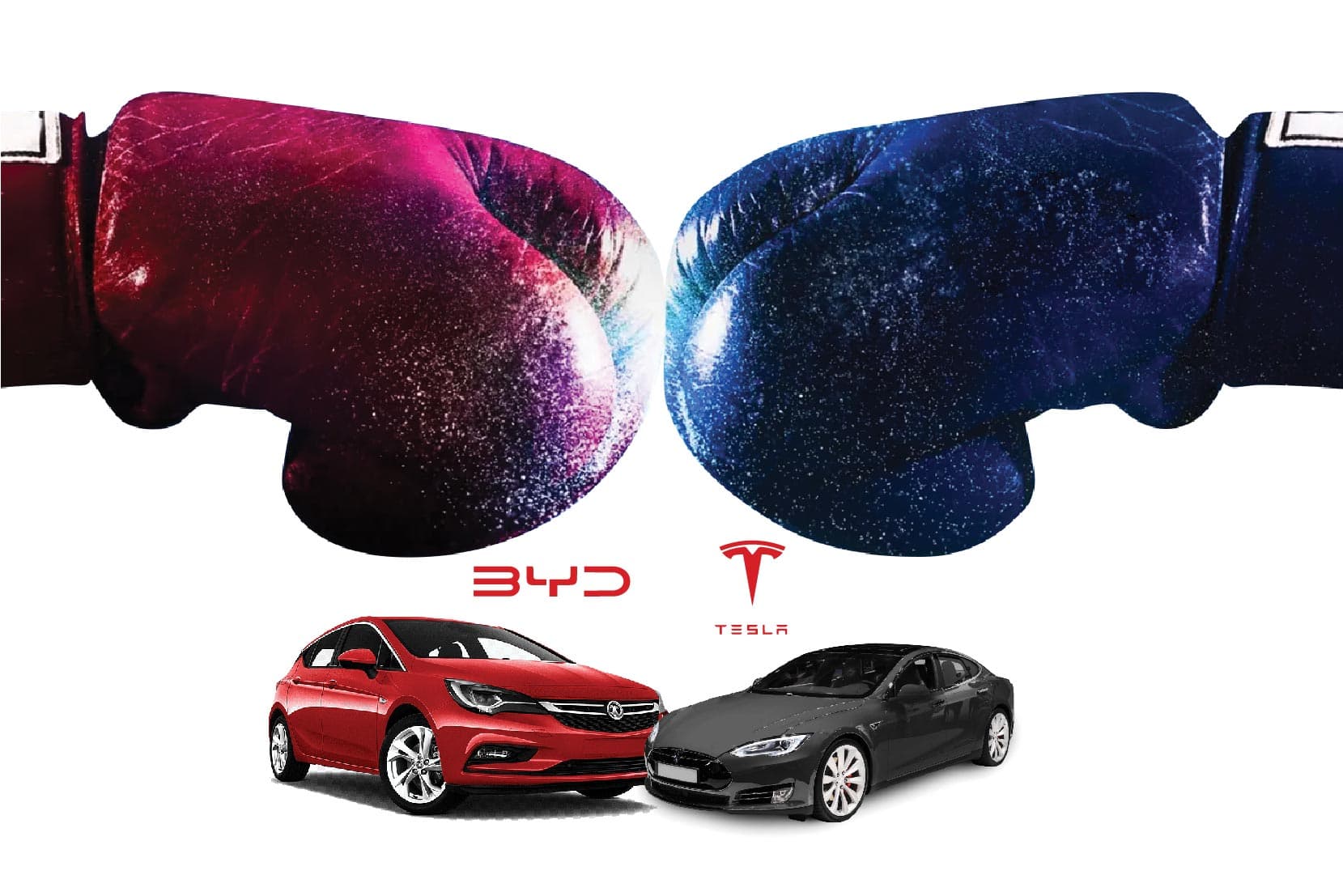
Illustrated By sk. yeahhia
6 April, 2025
The electric vehicle (EV) landscape is undergoing a seismic shift. For years, Tesla has been synonymous with EVs, setting the gold standard in design, technology, and innovation. But a new contender has emerged - BYD. Once a battery manufacturer, BYD has rapidly transformed into an EV powerhouse, overtaking Tesla as the world’s top-selling EV brand. With competitive pricing, cutting-edge battery technology, and an aggressive global strategy, BYD is rewriting the rules of the game. Here’s why Tesla should be watching its rearview mirror closely.
BYD’S WINNING EDGE
One of the biggest factors fueling BYD’s rise is its ability to produce high-tech, low-cost EVs for the masses. Unlike Tesla, which primarily targets the premium market, BYD focuses on affordability, making EVs accessible to a wider audience. The BYD Dolphin, for example, costs around USD 33,000 in Britain - nearly a third less than the Volkswagen ID.3. Meanwhile, the BYD Seagull is priced as low as USD 9,900 in China, making it an entry-level option for first-time EV buyers. In contrast, Tesla’s Model 3 and Model Y, even with occasional price cuts, remain significantly more expensive.
BYD’s cost advantage extends beyond just vehicle pricing. The company manufactures its own batteries, allowing it to reduce costs dramatically. The battery is the most expensive component in an EV, and by keeping this in-house, BYD has an edge over competitors who rely on third-party suppliers. This self-sufficiency enables the company to maintain thin margins while aggressively expanding market share, a strategy that has left legacy automakers scrambling to compete.
THE BLADE BATTERY REVOLUTION
Tesla may have led the charge in battery technology with its lithium-ion advancements, but BYD’s ‘Blade Battery’ is proving to be a game-changer. The Blade Battery offers superior safety, higher energy density, and increased longevity compared to traditional battery designs. It is also more affordable to produce, further cementing BYD’s cost leadership in the EV market.
Major automakers, including Mercedes, Ford, and Kia, have already turned to BYD for battery supply, recognising its technological prowess. This gives BYD a competitive advantage, not just as an automaker, but as a key supplier in the global EV ecosystem. While Tesla’s batteries are highly efficient, BYD’s Blade Battery is proving to be a formidable rival, offering a blend of affordability, safety, and performance that appeals to both consumers and industry players alike.

One of the biggest factors fueling BYD’s rise is its ability to produce high-tech, low-cost EVs for the masses. Unlike Tesla, which primarily targets the premium market, BYD focuses on affordability, making EVs accessible to a wider audience.
TESLA’S STRUGGLES IN CHINA
China is the world’s largest EV market, and it has been a battleground where Tesla once thrived. However, recent trends suggest that Tesla’s grip is loosening. The company has seen five consecutive months of declining sales in China, with this year's February shipments plummeting by 49% year-on-year. Even as Tesla has attempted to cut prices to maintain demand, its lineup remains relatively static compared to the dynamic offerings from BYD and other Chinese competitors.
BYD, on the other hand, has aggressively expanded its product lineup, offering not only electric cars but also hybrid vehicles, which remain highly popular in China. The company’s ability to tailor its models to local preferences, including software features optimised for Chinese driving conditions, has given it an edge over Tesla, whose globalised approach may not always align with regional consumer demands.
A GLOBAL EXPANSION STRATEGY THAT OUTPACES TESLA
While Tesla is expanding manufacturing in Germany and Mexico, BYD is strategically positioning itself across multiple continents. The company recently announced a new factory in Szeged, Hungary, allowing it to establish a European manufacturing base and avoid potential EU tariffs on Chinese imports. In addition, BYD is setting up operations in Brazil, Thailand, and potentially Mexico, ensuring a strong foothold in key emerging markets.
Tesla, in contrast, faces regulatory challenges that limit its global flexibility. The U.S. government has imposed strict rules on Chinese-made EV components, effectively keeping BYD out of the American market for now. However, in Europe, where Tesla has traditionally been strong, Chinese manufacturers are making rapid inroads. The Union Bank of Switzerland (UBS) estimates that Chinese automakers, led by BYD, will command one-third of the global EV market by 2030, posing a serious threat to Tesla’s dominance.
TESLA’S LAST STRONGHOLD?
Tesla still holds a major advantage when it comes to software, particularly with its industry-leading self-driving technology and charging network. The company’s Full Self-Driving (FSD) capabilities, despite regulatory hurdles, remain far ahead of most competitors. Tesla’s brand power and superior software integration still make it the go-to choice for tech-savvy consumers who prioritise advanced driver assistance systems.
However, BYD and other Chinese automakers are closing the gap. BYD’s 'God's Eye' advanced driver-assistance system is now being integrated into even its most affordable models, making features like lane-keeping and adaptive cruise control accessible to budget-conscious buyers. Similarly, Geely, another major Chinese EV player, is rolling out AI-powered navigation and self-parking systems across its brands. While Tesla’s software remains superior for now, the rapid development of China’s AI-driven automotive technology suggests that this lead may not last forever.
China is the world’s largest EV market, and it has been a battleground where Tesla once thrived. However, recent trends suggest that Tesla’s grip is loosening. The company has seen five consecutive months of declining sales in China,with this year's February shipments plummeting by 49% year-on-year.
CAN TESLA CATCH UP?
Despite BYD’s impressive rise, Tesla still has some advantages. It remains a premium brand with a strong global presence and unmatched brand loyalty. The company’s charging network, software capabilities, and continuous innovation in battery technology still set it apart from many competitors.
However, Tesla’s premium positioning means it cannot compete directly with BYD on affordability. The global EV market is shifting toward mass adoption, and BYD’s ability to deliver high-quality vehicles at a lower price point gives it a powerful edge. If Tesla wants to maintain its leadership, it may need to rethink its pricing strategies and product diversification.
One possible path forward for Tesla could be integrating more locally sourced components in China to reduce production costs. Another strategy could be offering more flexible pricing models for its software, including tiered FSD packages or subscriptions to attract a broader range of customers. Without such adjustments, Tesla risks losing more ground to BYD and other cost-competitive Chinese EV makers.
A NEW ERA IN THE EV RACE
The EV market is no longer a one-horse race. While Tesla remains an industry leader, BYD’s rapid ascent has reshaped the competitive landscape. With a combination of affordability, technological innovation, and aggressive global expansion, BYD is proving that it has what it takes to dominate the EV market.
Tesla’s brand power and software expertise will help it remain relevant, but the days of it being the undisputed king of EVs are over. The future of electric mobility will be defined by affordability and accessibility, areas where BYD is currently leading the charge. The question now is not whether BYD can sustain its growth, but whether Tesla can find a way to fight back.

%20Square%20Ad%20-10.jpg&w=640&q=75)
%20Square%20Ad%20-11.jpg&w=640&q=75)
%20Horizental%20AD-01.jpg&w=3840&q=75)
